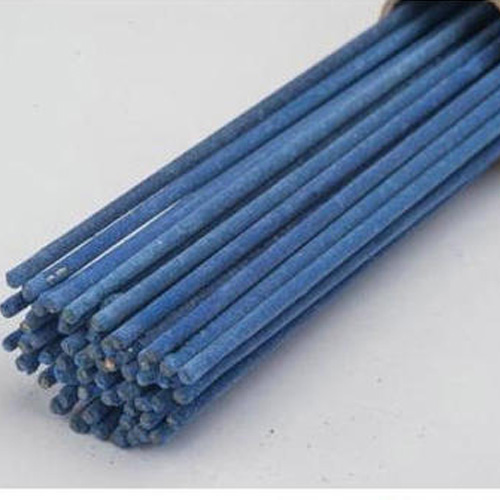
The metallurgical backbone of Vautid 100 is a high-chromium, high-carbon alloy on an iron base (Cr and C in balanced proportions) that forms a network of primary carbides in a ductile matrix. The typical hardness of the weld deposit is in the range of 60–63 HRC, providing a hard barrier against abrasive particle impingement. Unlike many competing electrodes, Vautid 100 overlays cannot be flame-cut or easily machined after deposition, ensuring the integrity of the hardened surface under operation. This hardfacing weld metal tolerates service temperatures up to 350 °C while preserving its microstructure.
From a welding specification standpoint, Vautid 100 electrodes conform to the DIN EN 14700 “E Fe 15 g / T Fe 15 g” classification for tubular and covered rods. Although the product line is not commonly documented under a single UNS designation, this hardfacing alloy is typically treated as a proprietary chromium carbide steel class (analogous to overlay alloy systems rather than standard UNS steels). The electrode is sometimes grouped under ASTM hardfacing filler standards although no single ASTM “Grade” is universally assigned in public literature. In industry practice, it functions as a universal standard hardfacing overlay consumable, often treated generically as a “high chromium carbide electrode.”
During welding, Vautid 100 Welding Electrodes exhibit stable arc behavior, zero slag formation, and excellent deposition efficiency — up to 200 % theoretical deposition yield is claimed for certain rod sizes. Because there is no slag, there is no slag removal step, enhancing productivity and reducing post-weld cleanup. The arc must be held as short as possible, and the electrode is welded with DC+ polarity (or AC in applicable variants), while preheating is generally discouraged to avoid stress cracking in the overlay layer. These electrodes are available in rod diameters of 3.25 to 6.0 mm and tubular wire equivalents from 1.2 to 3.2 mm.
The wear resistance of Vautid 100 is remarkable: in comparative tests, it can extend component life by a factor of 3 to 9 over plain structural steel (e.g. S235JR) under severe abrasive conditions. Its microstructure features a “Mikado” interlocking carbide arrangement that resists dislodgement under harsh abrasion cycles. Because it is not machinable or flame cut, it remains intact under continuous wear, minimizing defects and minimizing maintenance. This makes Vautid 100 Welding Electrodes a go-to consumable for overlaying scraper blades, mill liners, bucket lips, chutes, deflectors, and other high-wear parts.
Choosing Vautid 100 from Metals And Welding Specialities ensures you get quality assurance, batch traceability, and support in qualification. Our technical team can guide you in matching rod diameter, current settings, and overlay strategies to your equipment. Whether you aim to refurbish worn components or build new wear surfaces, Vautid 100 provides a balanced solution of abrasion resistance, weldability, and long life.
Specification Vautid 100 Welding Electrodes
Specification - Vautid 100 Welding Electrodes
Product Name
Vautid 100
Type
Coated Electrode for Hardfacing
Chemical Composition (Typical, %)
C: 4.5, Si: 1.2, Mn: 0.8, Cr: 30.0, Fe: Balance
Hardness (as deposited)
58 – 62 HRC
Welding Current
DC+ (Reverse Polarity)
Recommended Base Materials
Carbon steels, low alloy steels, and cast steels
Applications
Earthmoving equipment, crusher parts, agricultural tools, and wear plates
Deposit Characteristics
High resistance to abrasion, moderate impact resistance
Typical Layer Thickness
Up to 6 mm (single or multiple layers)
Electrode Sizes (mm)
3.2, 4.0, 5.0
Current Range (A)
3.2 mm: 90–130 A; 4.0 mm: 130–170 A; 5.0 mm: 170–220 A
Arc Characteristics
Stable arc with minimal spatter
Dilution
Low
Typical Coverage
Approx. 1.1 kg of electrodes per kg of weld metal
Storage
Store in a dry place; re-dry at 250°C for 1 hour if moisture absorbed
Vautid 100 Welding Electrodes Parameters
Parameter
Value / Range
Tensile Strength (Rm)
~ 82,000 psi (~ 565 MPa)
Yield Strength
~ 61,000 psi (~ 420-462 MPa)
Elongation (L = 5 d)
~ 25 %
Impact Strength (Charpy / ISO-V)
104 ft·lb @ 68 °F (~ 140 J @ 20 °C)
59 ft·lb @ 0 °F (~ 80 J @ −20 °C)
> 47 J @ −60 °C
Service Temperature Range
−60 °C to 350 °C
Electrode Diameters
2.5 mm, 3.2 mm, 4.0 mm, 5.0 mm
Welding Current / Amperage Ranges
2.5 mm → 70-90 A
3.2 mm → 100-130 A
4.0 mm → 130-170 A
5.0 mm → 140-190 A
Recommended Polarity / Current Type
DCEP / AC
Coating Type
Double (bipheric) coating, hydrogen-controlled, dual flux layers
Low Heat Input Feature
Yes